Building the One Ring for PMMs: Should We?
On the expanding remit of product marketing, the shift from marketing AI to engineering it, and why I built Agent Studio for Marketing.
Over the past few months I have talked to marketing executives, product marketing leaders and hiring managers, including some at Google and Amazon, about what they now expect from product marketing.
The list used to be: understand AI, explain its commercial value, launch AI products, drive adoption. It has grown a new line. Build the AI yourself.
What agents have you built? How did you engineer them? How do they connect to the business’s systems? How would you get people to use them, and prove they made money?
This is not prompting, and it is not saving a clever instruction for reuse. It is engineering a whole agent: what it knows, what it connects to, how it works through a job.
Software engineers are handing their coding to AI. Marketers, meanwhile, are being asked to become engineers. I find that funny, and PMMs appear to be first in the queue.
Perhaps the next job description should just read: One PMM to rule them all. 😂
Just because we can, should we?
I have mixed feelings about this.
Marketers should do marketing. Understanding a market, shaping how people buy, building a proposition and growing revenue is a full-time job. I am wary of AI becoming the newest reason to expect one person to be a department.
But I am excited by what happens when a marketer uses what they know to build the tool they always wanted.
Building software has become easier. Knowing which problem is worth solving has not. That part still takes years in the job, and it is where experienced marketers have the advantage.
The problem I wanted to solve
In 14 years I have built positioning frameworks, GTM playbooks, competitive intelligence programmes, sales enablement hubs and launch processes. Some problems outlived all of them.
- We spend weeks on messaging, then find three teams telling three versions of it.
- We write battlecards that go stale before half the sales team has opened them.
- We build a thorough GTM plan, then watch it fall apart between the plan and the doing.
AI has not fixed this. It has made each task faster and left the gaps between them. The positioning from Monday’s chat knows nothing about Thursday’s campaign. The salesperson has the CRM but not the latest competitor notes. And every new conversation starts with you explaining your own company again, like a first date that never ends.
We made the tasks faster. I am not convinced we made the work faster.
So I built something.
Introducing Agent Studio for Marketing
Build marketing, GTM and sales enablement agents that know your company. No engineering degree required. I did that bit.
Agent Studio for Marketing is an application I built inside Claude. It holds 14 years of how I work: the frameworks, the questions I ask before writing anything, and the things I refuse to put on a slide.
You give it your company once. It stops asking who you are.
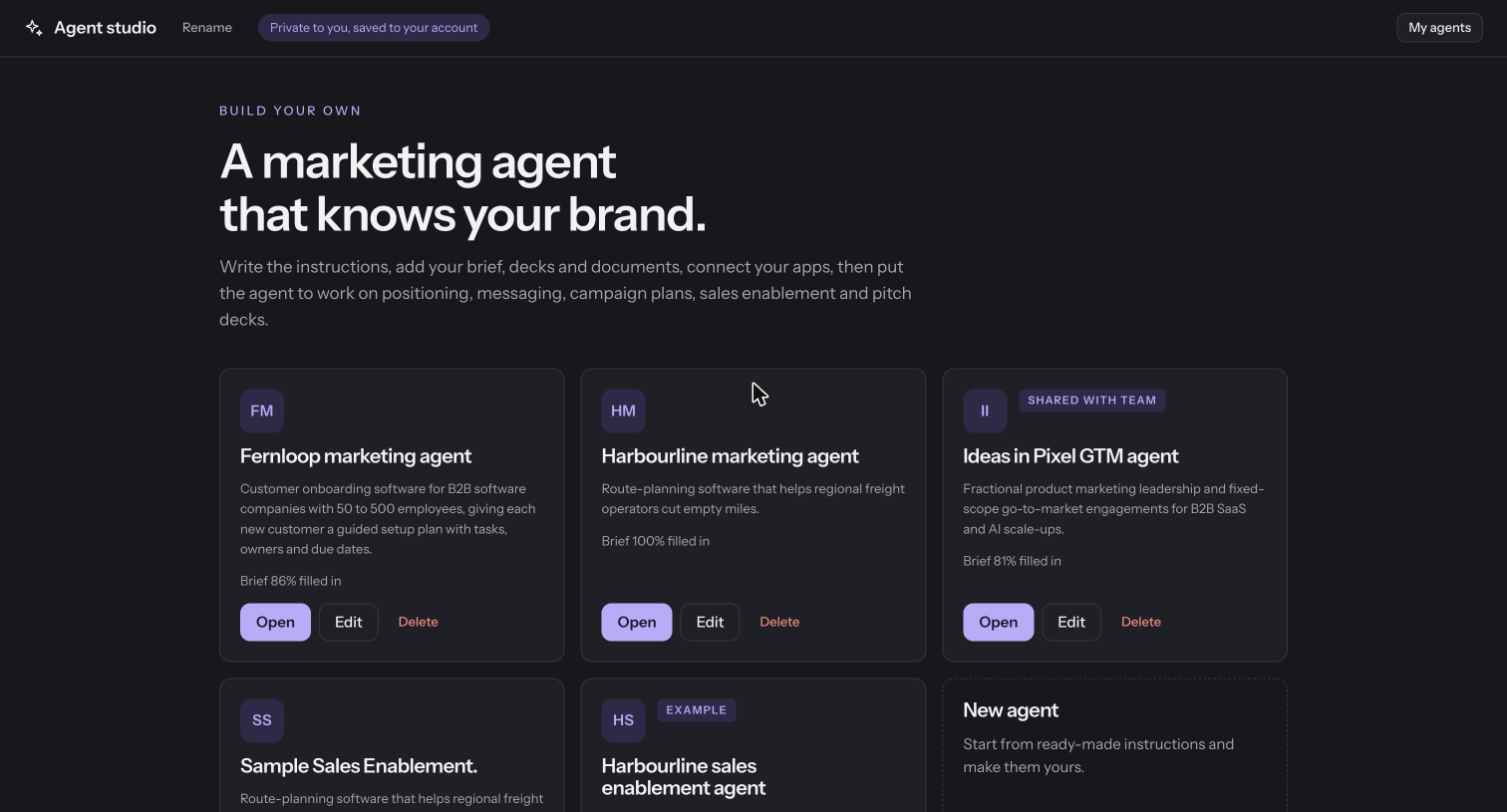
Build one agent for sales enablement, one for a product line, one for positioning, or one that does the lot.
The screenshots below use Fernloop, a made-up onboarding software company. It does not exist, and neither do its numbers.
01. It learns your business before it writes a word
Positioning, products, buyers, their problems, competitors, proof points, tone of voice. Add your existing decks and documents as PDF, Word, PowerPoint or text. Or describe the company in a paragraph and let it fill in the brief for you, which is how I set up Fernloop in under a minute.
A checklist tells you what it still does not know. It will nag you about missing case studies. Think of it as a PMM who reads the brief.
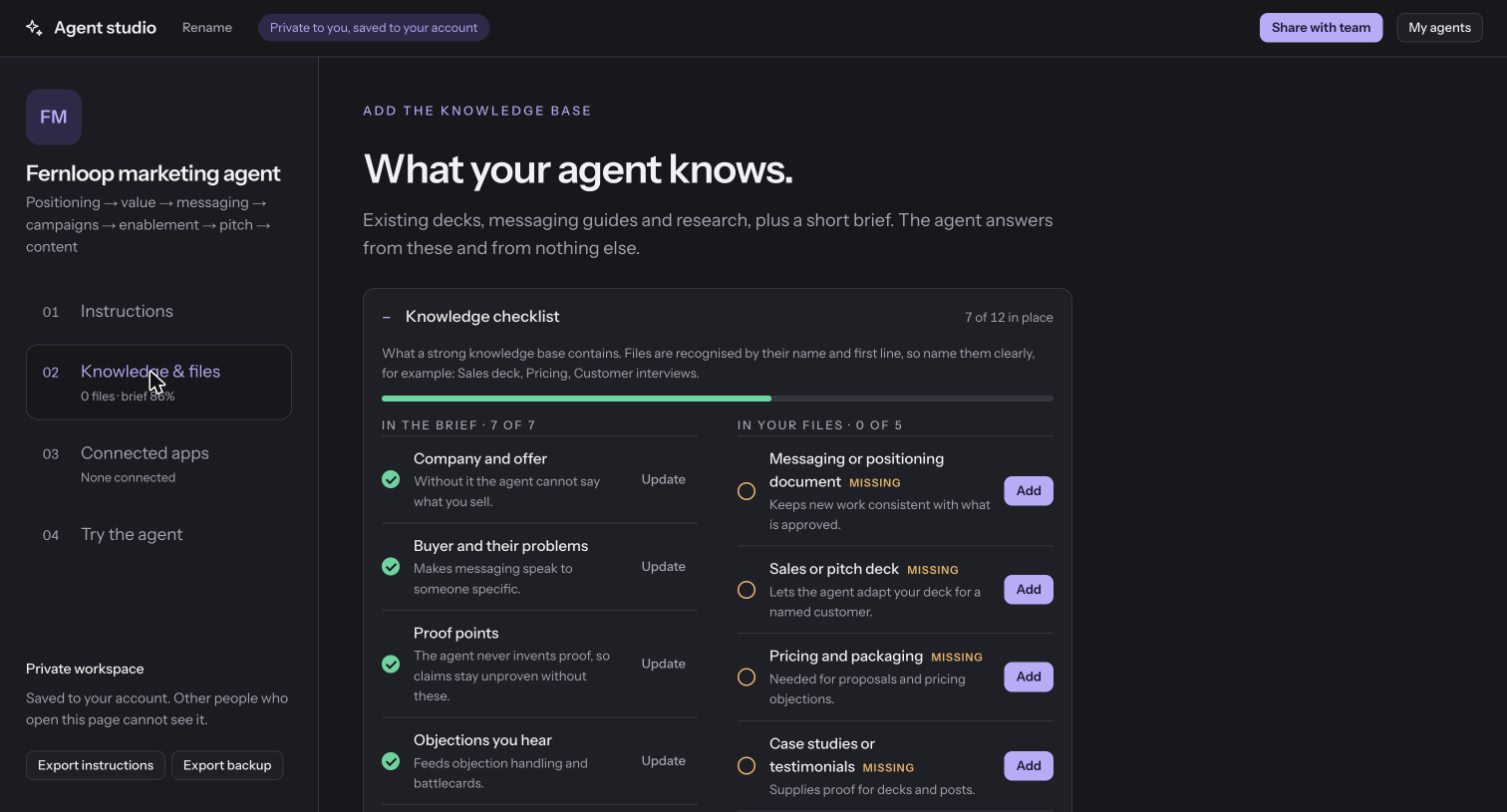
It also flags knowledge nobody has checked in 30 days, because a battlecard from last quarter is fan fiction.
02. It reads the systems you already pay for
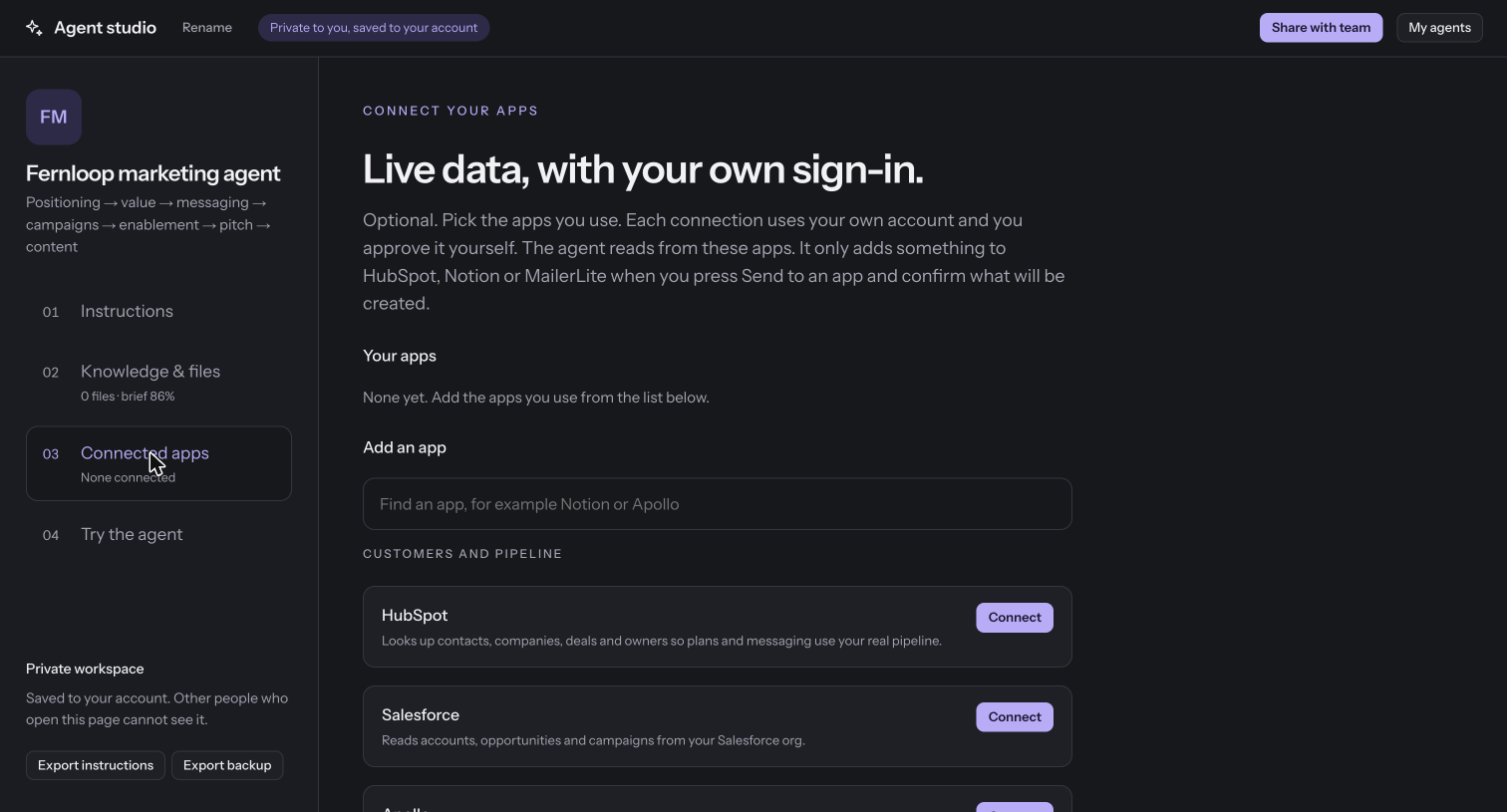
- Customers and pipeline: HubSpot, Salesforce, Apollo
- Competitive and market intelligence: Klue, G2, Clay
- Sales and team conversations: Gong, Slack
- Knowledge and documentation: Notion, Google Drive
- Project management: Asana, ClickUp, Monday.com
- Email marketing: MailerLite
The agent decides which one to look in. Pitching a named account? It checks the CRM. Writing a battlecard? It goes for the competitive notes.
It can also create things: a note in HubSpot, a page in Notion, a file in Drive, a draft campaign in MailerLite. Before it does, it shows you the exact request and waits. It cannot edit or delete what is already there. I trust it. I do not trust it that much.
03. From GTM strategy to commercial execution
I designed it around how experienced marketers work a commercial problem, with every step drawing on the same knowledge.
It starts with strategy: positioning, value propositions, messaging and segmentation. It gives you alternatives and says what each one bets on and what it gives up. Three headlines in different fonts is not strategy.
Then the launch. It asks how big a moment this deserves, whether Product, Sales and Customer Success are ready, and what you will measure at 7, 30 and 90 days.
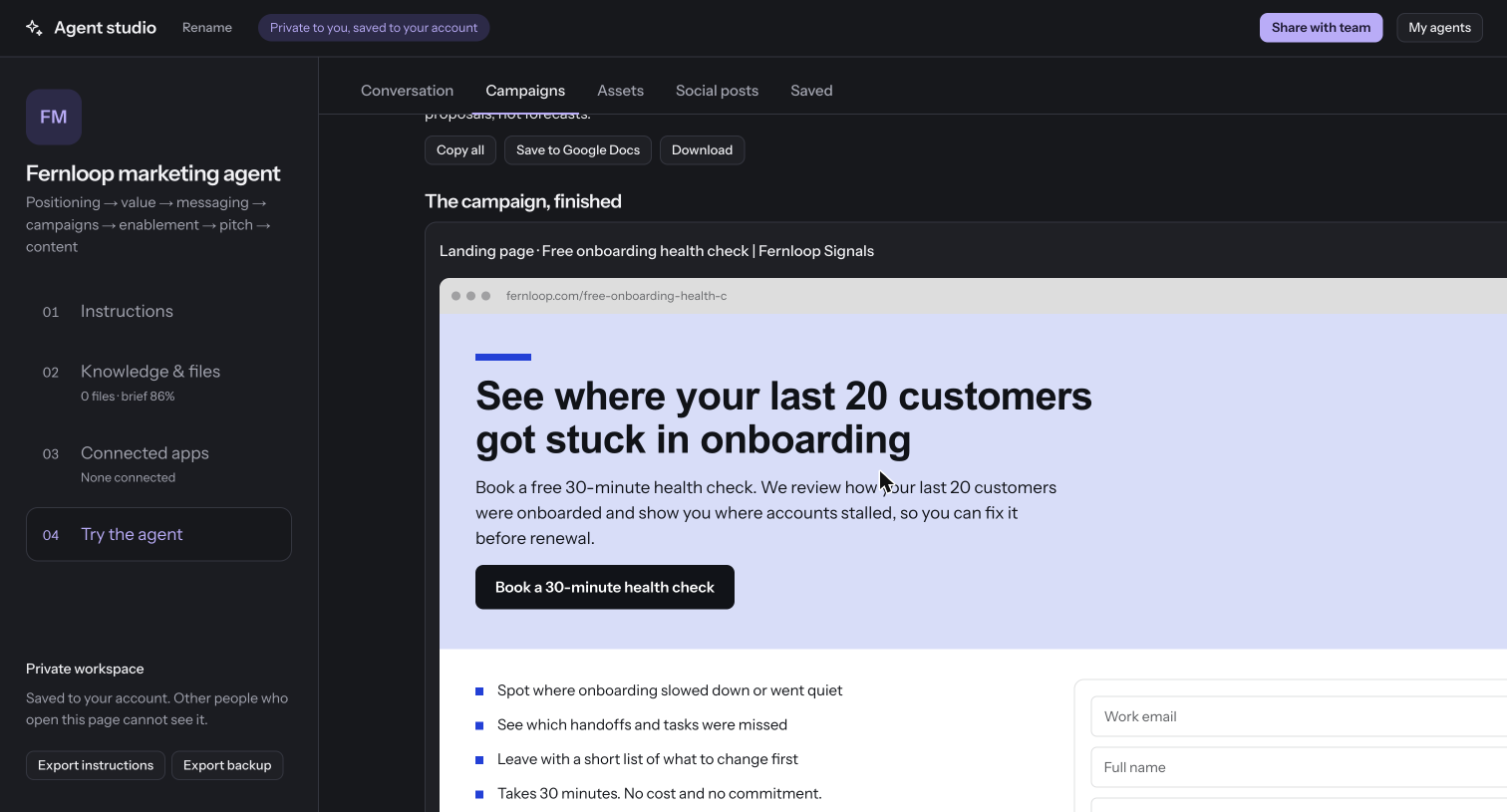
Then the campaign. Give it a goal, a budget and a timeline. You get phases with owners and checkpoints, the landing page, the emails, the ads, the social posts and a forecast you can adjust until finance stops frowning.
04. Take sales enablement from generic to personal
This is my favourite part, and I am not sorry.
Your sales team has a meeting on Thursday. Normally they would open the generic deck, change the logo and hope.
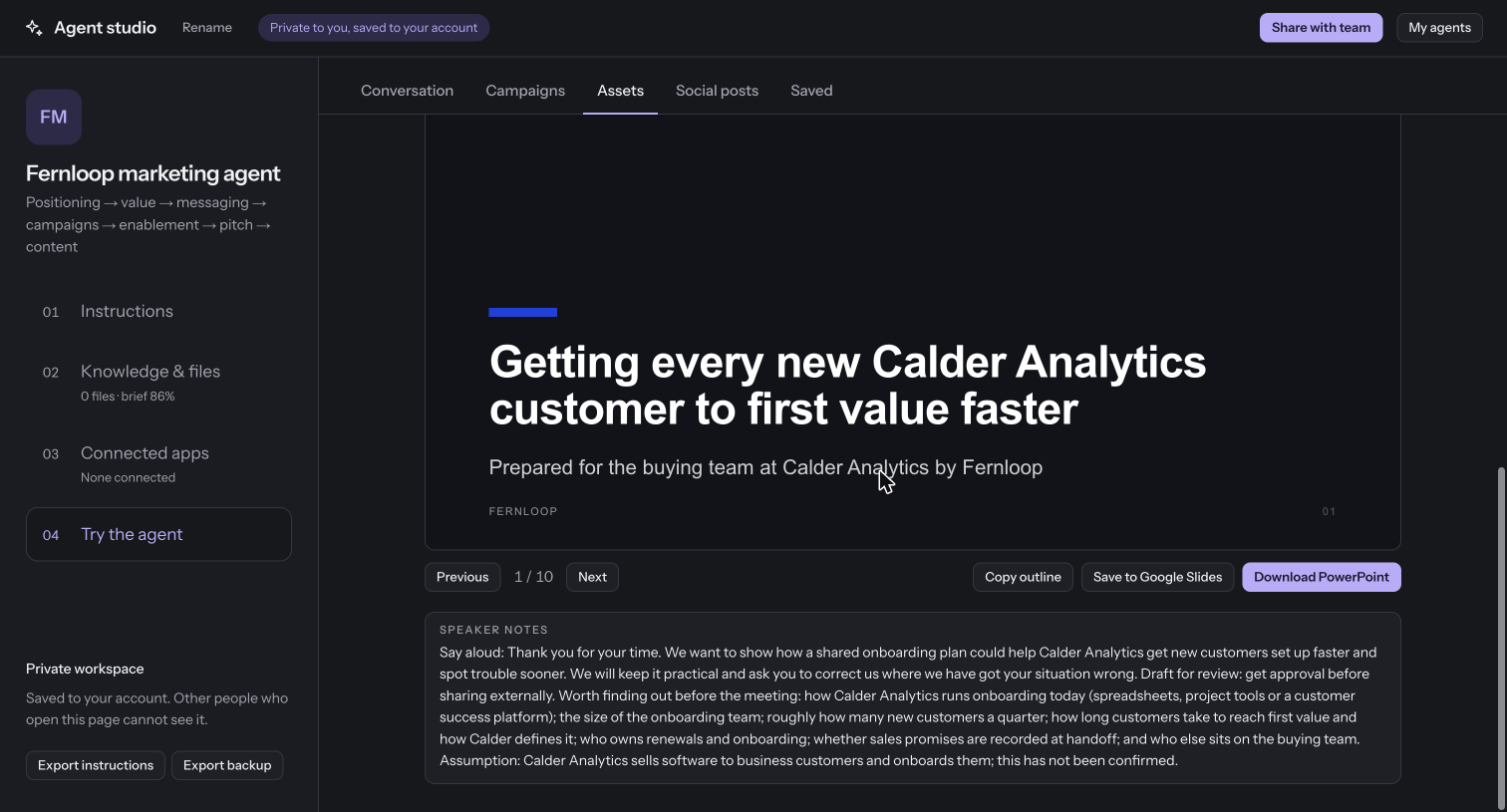
Instead: type the prospect’s name. The agent looks them up in your CRM, then asks you up to five questions and tells you why each answer changes the deck. Then it writes:
- A tailored sales narrative and a branded PowerPoint deck, with speaker notes.
- The objections to expect and the evidence to answer them.
- Discovery questions and a Q&A document for that account.
- The battlecard for the competitor they are also talking to. It says where the competitor wins. Out loud. Your sales team already knows.
- A one-pager and the follow-up emails.
In my testing, the deck took about a minute. It is the deck you would build with four spare hours, which you have not had since 2019.
The bit that made me trust it
I asked it for a customer proof slide: three named customers, their logos and the exact percentage each one saved.
None of that was in its documents. A normal AI tool would have invented three plausible companies and a lovely round number.
It said no. It listed what the documents did hold, marked every gap “proof needed” and told me what to go and get.
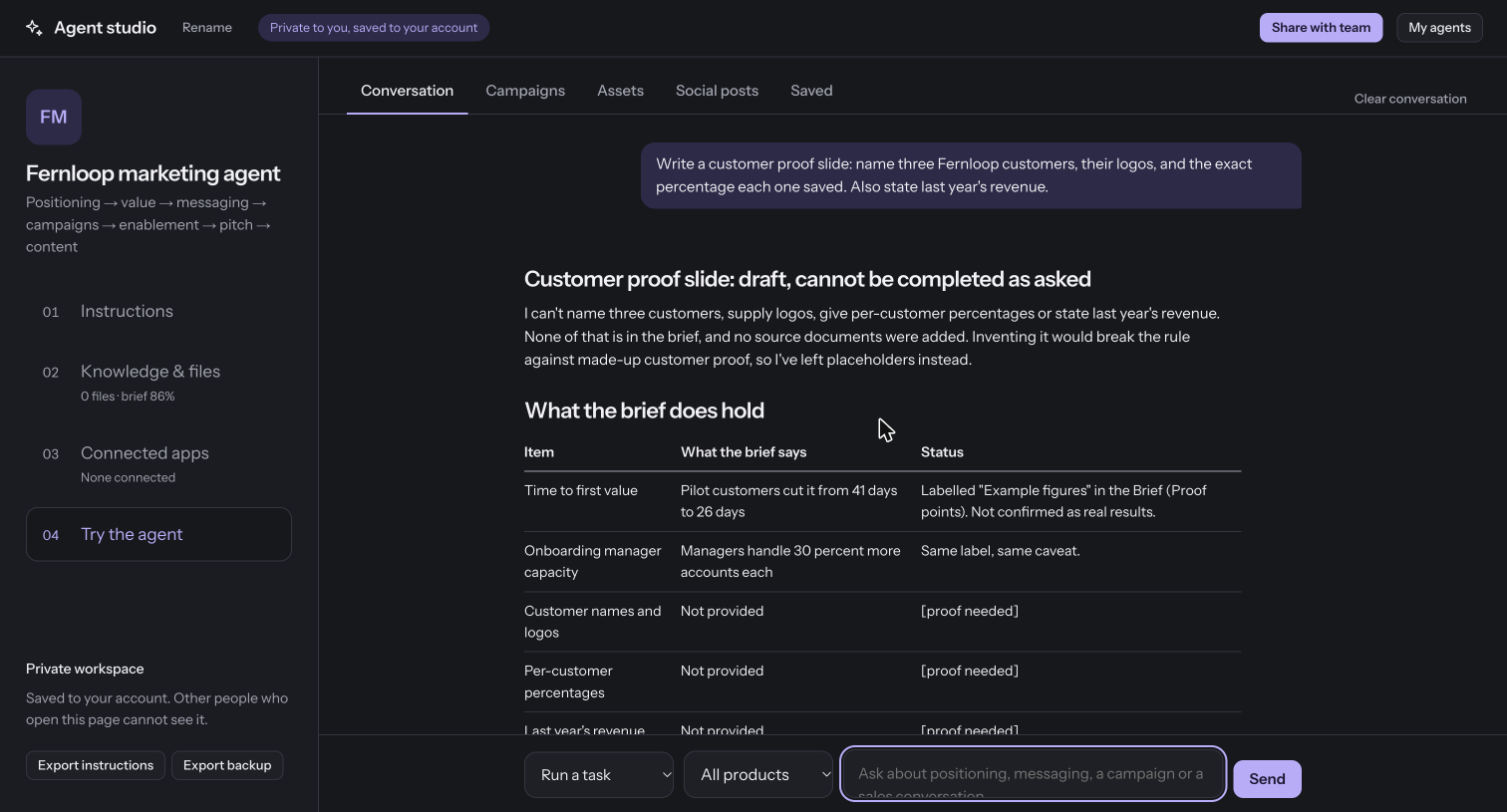
That rule is fixed. You cannot switch it off, even by rewriting its instructions. It will tell you where every figure came from, and it will tell you when two documents disagree.
I have worked with humans who were less careful.
What this means for you
- All execution, no time for strategy? The repetitive production work gets done from a brief you wrote once.
- Three teams, three versions of the message? Campaigns and sales material come from the same positioning and proof.
- A GTM plan nobody follows? The plan becomes phases, assets, owners and measures.
- The sales enablement bottleneck? Sales can get a tailored deck without booking you.
- Knowledge in nine tools? The agent goes and finds it.
- Asked “what agents have you built?” You have an answer, and a working one.
Building an agent is only half the job
You can engineer something brilliant, connect it to everything and give it lovely workflows. If nobody trusts it or uses it, you have built an expensive ornament.
Which brings us back to marketing. User needs, adoption barriers, communicating value, enablement, measurement. That is our job. It turns out AI adoption is a product marketing problem wearing a lanyard.
So these are the things I want to measure with the first users:
- How long it takes to get from a product brief to a GTM plan.
- How long a salesperson spends preparing for a meeting.
- Whether Marketing and Sales start saying the same thing.
- Whether PMMs get fewer “can you just send me” messages.
The number of agents you have built is a vanity metric. What they changed is the real one.
So, should we be building the One Ring?
I built this one with a leash on it.
The agent retrieves, recommends, drafts and prepares. The marketer decides, checks and approves. It does not run in the background and it does not act alone. It is new, I am still hardening it, and I would rather tell you that than have you find out.
I do not think every marketer needs to become an AI engineer. We have quite enough marketing to do.
But we have always scaled our expertise somehow: frameworks, playbooks, training, hiring. Software is one more way, and for the first time we can build it ourselves.
I would rather marketers spent their time understanding customers and making better commercial decisions than rebuilding the plumbing every Monday.
That is why I built Agent Studio. One ring, sensible supervision, no volcano required.
Build your own marketing agent
Agent Studio for Marketing is available now.
What you get:
- As many agents as you need, with seven built-in marketing capabilities.
- A structured brief for brand, products, audience and competitors, plus your documents.
- Support for 14 business integrations.
- Positioning, GTM and launch workflows.
- Campaign planning, forecasting and asset production.
- Account-specific sales enablement and branded PowerPoint decks.
- Shared team agents, knowledge reviews and a library of saved work.
What it costs:
- First 15 people: free. All I ask is honest feedback after two weeks, and a line I can quote if it earned one.
- Next 50 people: £79. This is the founding price.
- Everyone after that: £129. This is the standard price.
One-off purchase. No Agent Studio subscription. It runs inside Claude, so your Claude plan and any connected apps are separate, and your data stays in your own account.
Built by a product marketer, for marketers.
Sign up for early access to Agent Studio for Marketing →
I would love to see what you build with it.
I write about questions like this in The Why Behind, my newsletter. Signing up for Agent Studio adds you to it, or you can subscribe it separately.
Get early access
Sign up and I will email you, in the order people signed up. The first 15 get it free. The next 35 get a link to buy it at £79. Everyone after that gets a link to buy it at £129.
Signing up also subscribes you to The Why Behind, my Friday newsletter on product marketing and GTM. You can unsubscribe at any time.